
ECOnti
Digital Twin for Continuous Bioproduction
A continuous E. coli process only pays off if every step stays stable for weeks. In ECOnti, a digital twin built from CFD, hybrid process models and plant automation kept the whole chain in balance.
Challenge
Continuous bioproduction depends on long-term stability.
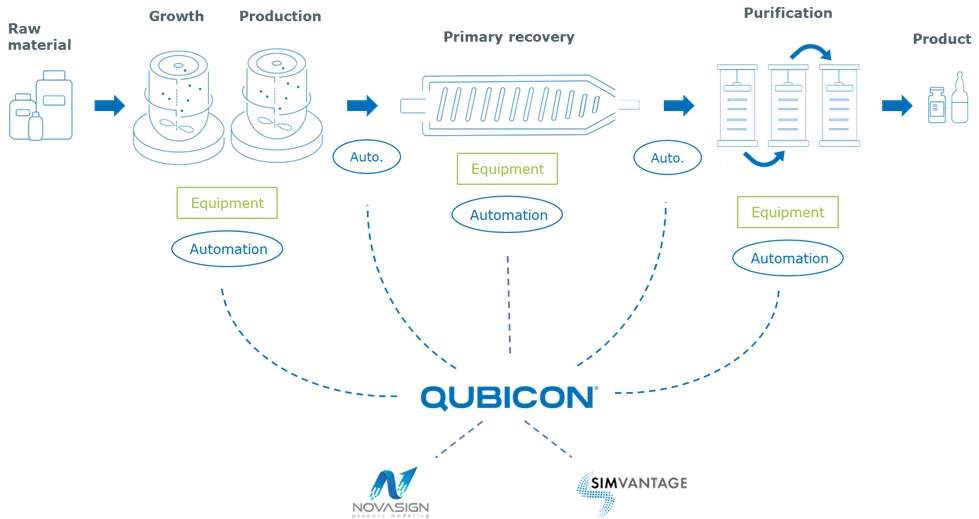
A continuous process makes more product with smaller equipment, and it costs less to run. That only works while growth, production, primary recovery and purification stay in balance for weeks. So operators need models that tell them how each step will react when conditions change.
In this FFG-funded project, enGenes Biotech covered E. coli expression and BOKU and Tosoh the purification. Qubicon brought the automation, Novasign the hybrid process models and SimVantage the mechanistic CFD.
Results
30 Days of Stable Continuous Production
With the twin in the loop, the continuous E. coli process ran stably for 30 days. Operators saw mixing time, holdup and average shear rate from the CFD model right next to the process parameters in the control system.
- 30Days of stable continuous E. coli production
- 6Partners along the process chain
- 1Connected model for the whole process chain
Facing a similar question? Let's talk.
Tell us about your reactor and your bottleneck. We will show you what simulation can quantify before you change anything in steel.