
Peer-Reviewed PublicationProcesses 2026 · Open access · with HS Niederrhein and TU Graz
Vortex Formation in a Stirred Tank
Measured and Predicted
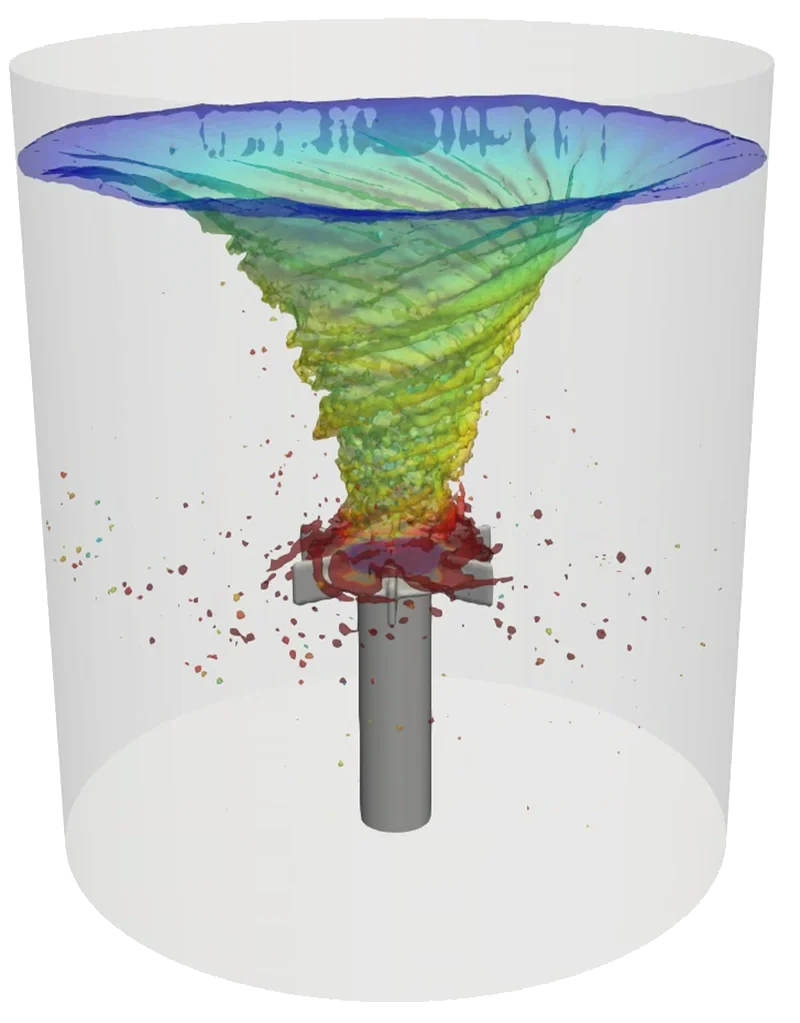
In the lab, a Rushton turbine tank (stirred by a six-blade radial disc impeller) ran with five different baffle setups while a camera filmed the vortex. Every setup was then simulated with the SimVantage free-surface model, which tracks the moving liquid surface.
Challenge
Vortex formation has to be designed for.
In most stirred tanks, a vortex that reaches the impeller means air in the impeller, lost power and a vibrating drive. Engineers can predict whether a vortex forms. Predicting its depth has been much harder, because the available correlations are fifty years old and ignore baffles entirely.
Some processes do want a surface vortex, for surface gassing or to draw down floating solids, and there its depth matters just as much.
Results
Vortex Geometry Predicted Without Fitting Factors
Main Findings
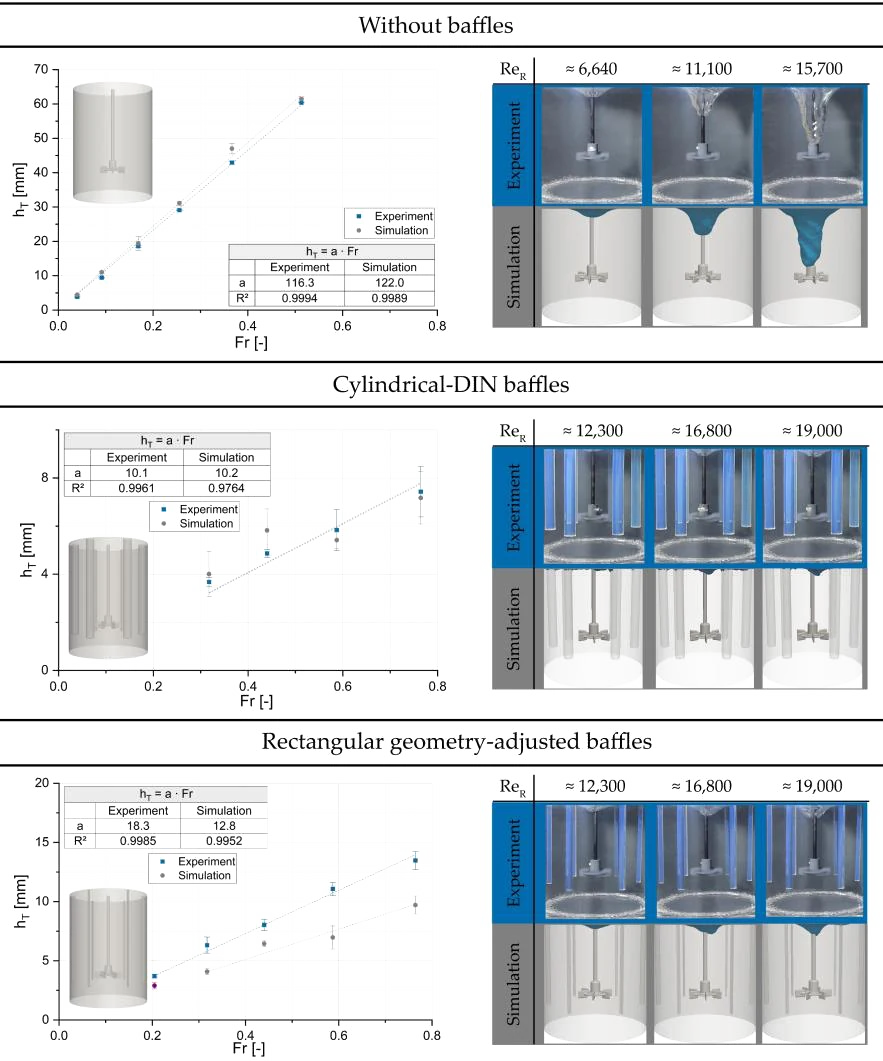
- Baffle shape changes when a vortex starts. At the same baffle index, a tank with cylindrical baffles can run at much higher stirrer speeds than one with rectangular baffles before a vortex forms.
- Vortex depth grows in a straight line with the Froude number (ratio of inertial to gravitational forces). Once you know the depth, you know the volume. Width stops growing at a limit set by the vessel.
- The new depth correlation uses a swirl number, a measure of how strongly the liquid rotates, read from the simulated flow field. Because it comes from the actual flow, the swirl number already contains the effect of the baffles, and the correlation needs no constants fitted to one particular geometry.
- If your process cannot tolerate a vortex, rectangular DIN baffles are the cheaper way to prevent one, because they use less material, are easier to build and draw less power.
Scope: single-stage six-blade Rushton turbine, flat-bottom vessel, D = H = 110 mm, water. The paper lists the deviation for each configuration and the limits of the study.
Publication
Experimental and Computational Investigation of Vortex Formation in a Single-Stage Rushton Turbine Stirred Tank Reactor Under Standard and Non-Standard Baffle Configurations
Facing a similar question? Let's talk.
If vortex formation, surface aeration or baffle design limits your process, we can simulate your own tank across your operating range before you change any hardware.