
Scale-Up with Hybrid Models
First-Principle Accuracy at Machine-Learning Speed
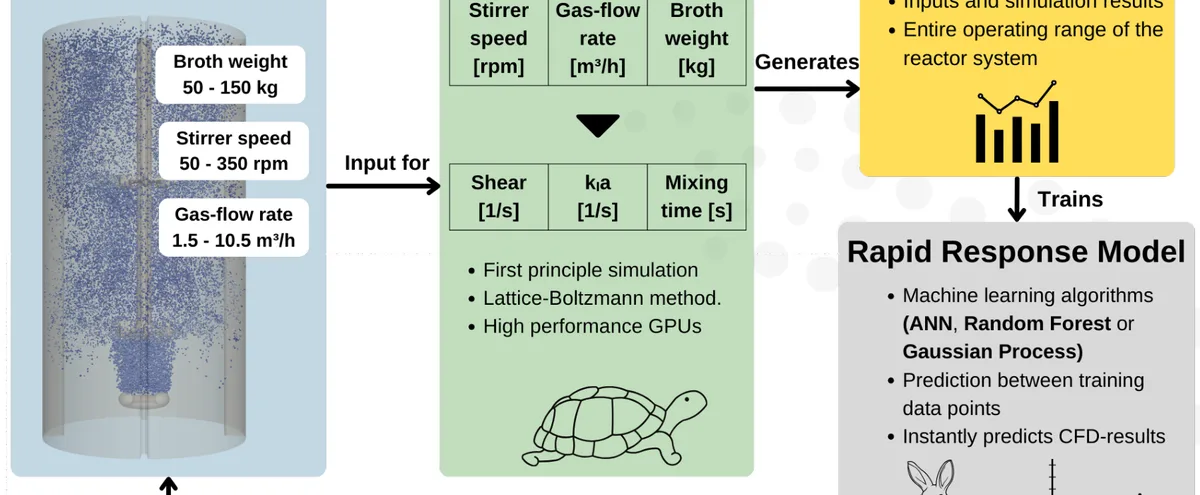
Get shear, kLa (oxygen transfer coefficient) and mixing time within milliseconds, even in reactors where correlations fall short. We simulate the reactor’s operating range once with mechanistic CFD and train a neural network, the rapid-response model, on the results. That model then answers for any operating point in the range.
Challenge
Resolved CFD is too slow for screening operating points.
A resolved two-phase simulation of a production reactor gives you exactly the numbers scale-up needs, from shear rate distributions to kLa and mixing time. Each operating point takes hours, though, so screening hundreds of candidates is out of the question. Classical correlations answer instantly. Once the geometry or flow regime moves away from the data they were fitted to, their answers stop being reliable.
Approach
CFD Sweep of the Operating Range as Training Data
We simulate the reactor across its operating range with the lattice-Boltzmann method, a first-principle CFD method that runs efficiently on GPUs. In one example, the sweep covered 50–150 kg of broth, 50–350 rpm and 1.5–10.5 m³/h of gas. Neural networks trained on these results, the rapid-response models, then return single values and full distributions in milliseconds.
Validation
Xcellerex™ XDR-2000 Model Trained on 25 Operating Points
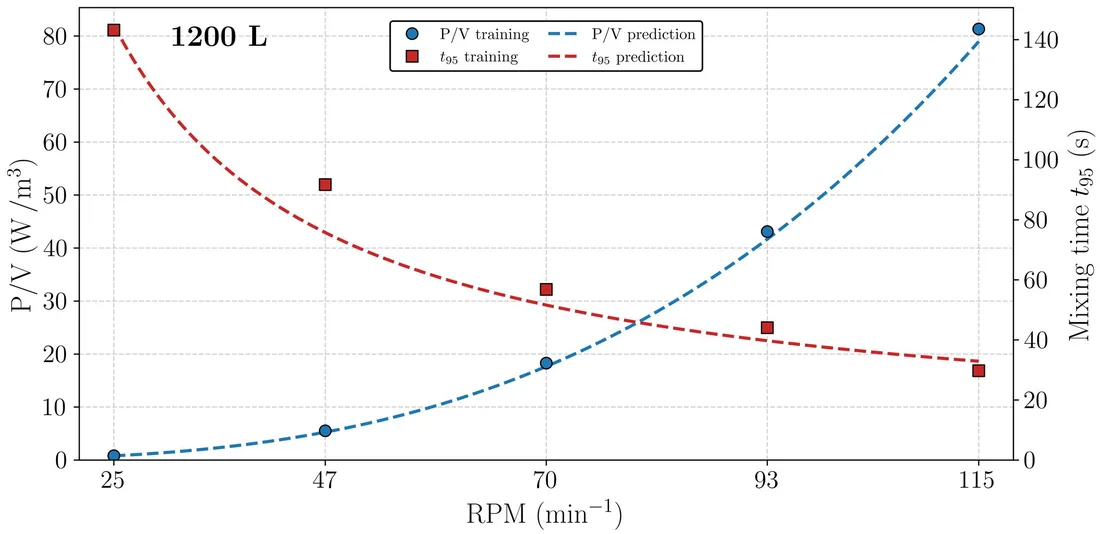
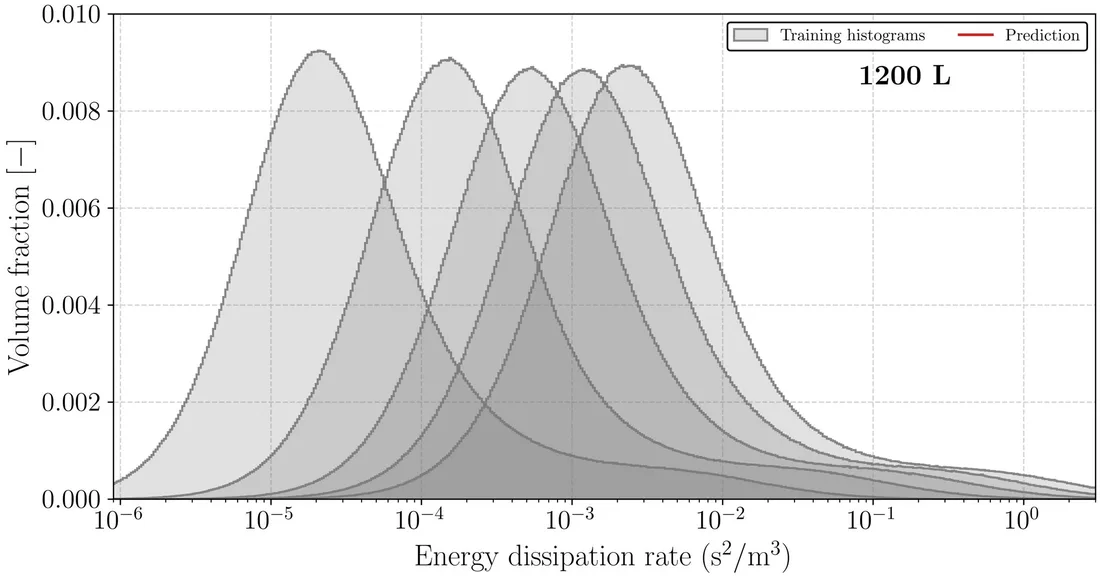
For the single-use XDR-2000, with a validated design space of 25–115 rpm and 400–2,000 L, we trained the model on 5 stirrer speeds × 5 working volumes. Then we tested it at operating points it had never seen. Its predictions match the CFD results there, for single values such as P/V (power input per volume) and mixing time and for the full energy-dissipation distributions.
Results
In-Silico Scale-Up in Minutes, Available in SmartScaler
Paired with an optimizer, the rapid-response models find the operating point in a target reactor that reproduces the flow conditions of the source reactor. In a proof of concept we moved a 2 L process at 500 rpm and 0.05 m³/h to a 100 L vessel. To match kLa and shear distribution there, the models suggested ≈336 rpm at ≈2.2 Nm³/h.
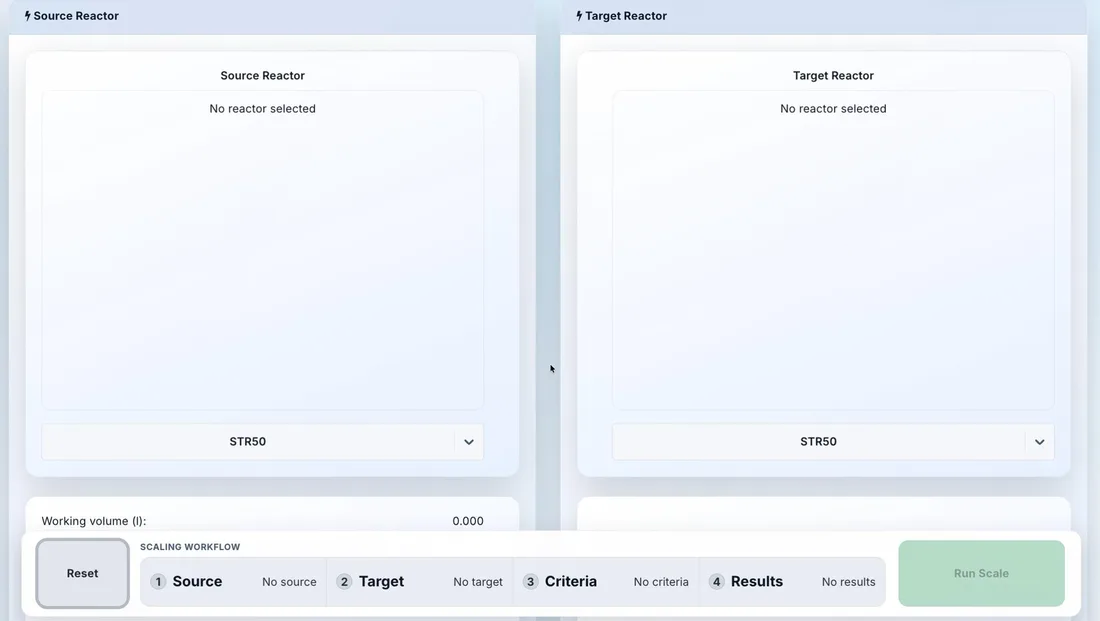
SmartScaler, our cloud-based scale-up tool, is built on this method. You can try it with a free demo account.
Facing a similar question? Let's talk.
Tell us about your reactor and your bottleneck. We will show you what simulation can quantify before you change anything in steel.