
Peer-Reviewed PublicationBiotechnology & Bioengineering 2022 · with Sandoz, TU Graz, BASF and CureVac
Reactor Optimization – Sandoz Kundl
Impeller Redesign at 160 m³
Sandoz wanted a 160 m³ production bioreactor to draw less power by alternating radial and axial impellers. Tracer tests and CFD (computational fluid dynamics) showed which configuration would work before any impeller was changed in steel.
Challenge
Stirring a 160 m³ fermenter is a major cost factor.
In a large fermenter, a good part of the production cost goes into stirring and aerating the broth. The classic setup puts a Rushton turbine (radial-flow disc impeller) on every level. That breaks up the gas well, but it draws far more power than axial impellers do. Axial impellers save power, yet near the bottom of the tank they handle gas poorly.
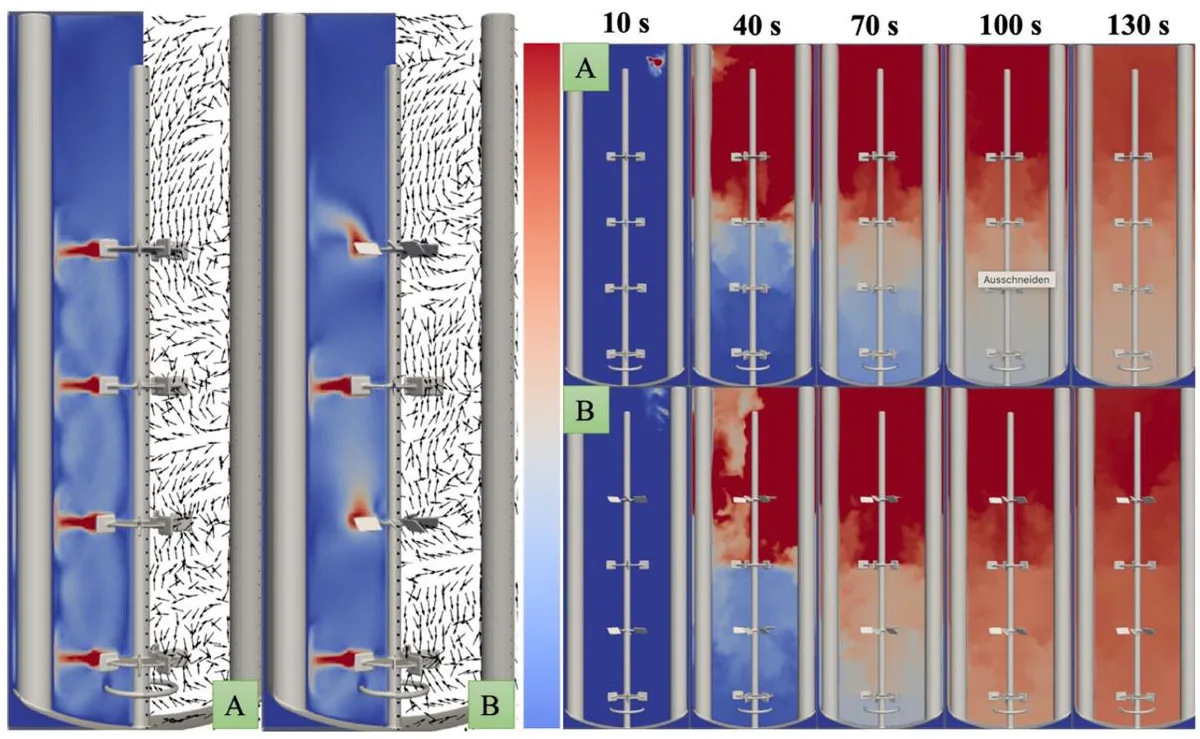
Alternating the two types looks like a good compromise. Before touching the vessel, though, Sandoz had to know whether it would still disperse the gas and mix as fast while drawing less power in a real 160 m³ reactor (Ø 4.25 m, 100 rpm).

Approach
Full-Scale Validation Before Virtual Optimization
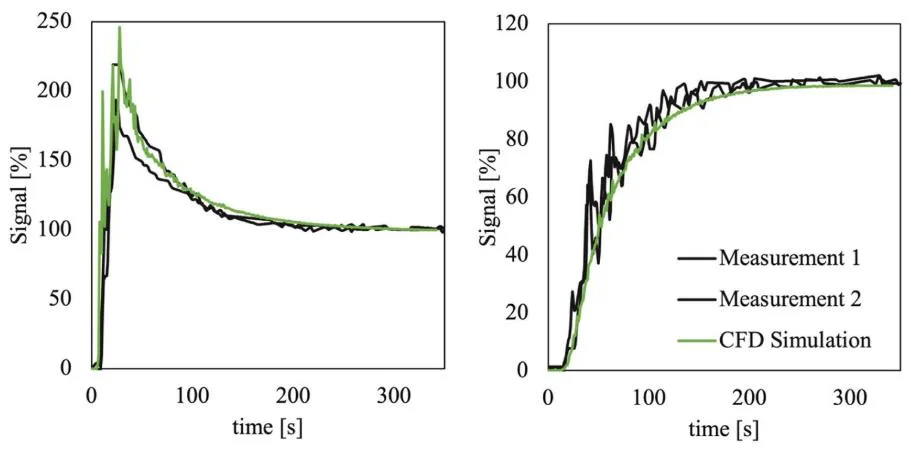
Before anyone trusted the simulation, it had to match the real 160 m³ production reactor, and validation at that scale is almost never possible. A tracer was injected and followed with probes until the vessel was evenly mixed. SimVantage's GPU-accelerated CFD software reproduced the measured mixing curves. From then on, Sandoz engineers could try stirrer systems on the computer and compare them until they found the best one. Only that configuration went into the real reactor.
Outcome
Implemented in Production and Publicly Reported
The new configuration saves roughly €350,000 and 3,740 MWh per reactor each year. With alternating radial and axial impellers, the reactor holds about as much gas as before (gas holdup, the gas volume fraction in the liquid) and mixes much better at the same operating conditions. In production, mixing time dropped by 30% and energy demand by 20%. Sandoz has reported the savings at Kundl publicly, along with the roll-out of the upgrade to further large fermenters.
Publication
Analyzing the effect of using axial impellers in large-scale bioreactors
Facing a similar question? Let's talk.
Tell us about your reactor and your bottleneck. We will show you what simulation can quantify before you change anything in steel.